
The current Tsavo park entry fees are KES 1,000 for East African citizen adults, KES 1,350 for Kenya resident adults, USD 80 for non-resident adults, and USD 40 for African citizen adults. Children and students pay reduced rates: KES 500 for East African citizens, KES 675 for Kenya residents, USD 40 for non-residents, and USD 20 for African citizens. These rates apply to both Tsavo East National Park and Tsavo West National Park.
Below is a summary table with applicable latest current entrance fees for Tsavo West and Tsavo West National Parks:
| Visitor category | Adult fee | Child/student fee |
|---|---|---|
| East African citizen | KES 1,000 | KES 500 |
| Kenya resident | KES 1,350 | KES 675 |
| Non-resident | USD 80 | USD 40 |
| African citizen | USD 40 | USD 20 |
The Kenya Wildlife Service (KWS) officially gazetted new park entry fees in late September 2025 under the Wildlife Conservation and Management (Access and Conservation) (Fees) Regulations, 2025. This is the first major fee revision in nearly 18 years, replacing rates that had remained unchanged since 2007. It’s important to note that the Park entry fees do not change every year and next revision is unlikely for the next few years.
The new fees took effect on October 1, 2025, but were temporarily suspended by a High Court order on October 2, 2025, following a petition by the Kenya Tourism Federation (KTF). Despite the injunction, the KWSPay system on eCitizen continues to display and charge the new 2025 rates, pending the court’s final decision expected in November 2025.
This TsavoKenya.org guide provides a breakdown of the entrance fees for Tsavo East and Tsavo West, covering East African citizens(including Kenyans), African citizens, residents, and non-residents, as well as important details on categories, payment, exemptions, KWSPay links, Park permit rules, and additional charges.
📈 The Big Picture: How Much Have Tsavo Park Fees Increased?
The 2025 revision represents a sharp yet strategic adjustment in KWS pricing — designed to reflect true conservation costs, align with regional benchmarks, and sustain infrastructure and security operations in Kenya’s largest protected area.
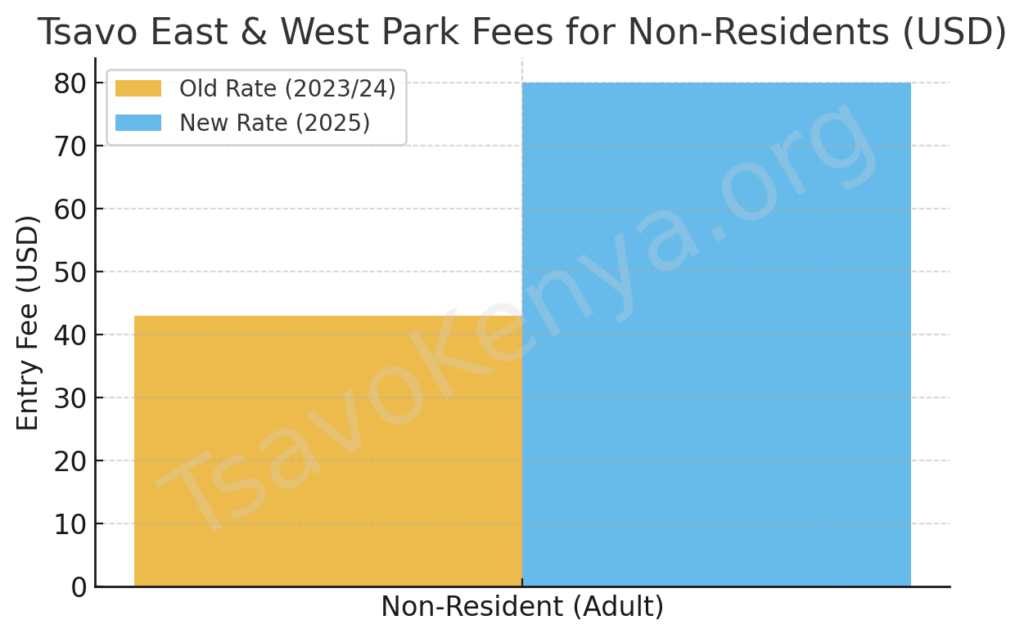
| Category | Old Rate (2023/24) | New Rate (2025 & 2026) | % Increase |
|---|---|---|---|
| East African Citizen (Adult) | KES 430 | KES 1,000 | +133% |
| Kenya Resident (Adult) | KES 515 | KES 1,350 | +162% |
| Non-Resident (Adult) | USD 43 | USD 80 | +86% |
| Child (All Categories) | 50% of adult | 50% of adult | — |
In short, the average increase across all categories ranges between 80% and 160%, depending on nationality — a move KWS describes as necessary for maintaining financial sustainability in the face of rising management costs, climate-related restoration projects, and anti-poaching patrol expenses.
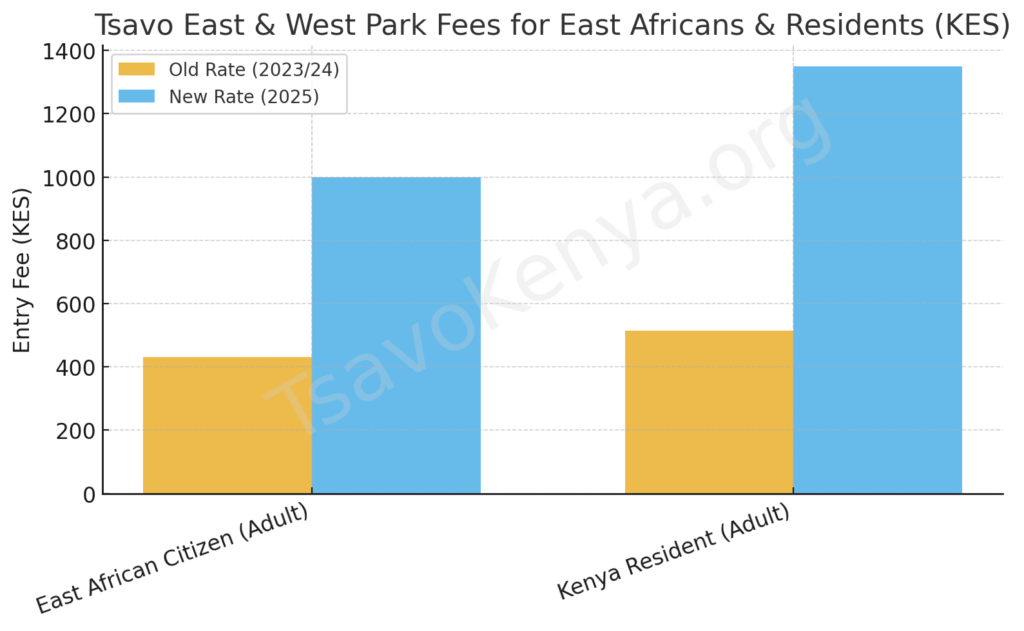
Even after the revision, Tsavo’s rates remain significantly lower than the Masai Mara, where non-resident fees now reach USD 200 per day in peak season, and at par with Tanzania’s Serengeti National Park, which charges USD 71 per adult per day. Tsavo Parks now charge $10 lower than Nairobi National Park whose non-resident adult rates currently stand at $80 for as per NairobiPark.org.
Does one Tsavo ticket cover both Tsavo East and Tsavo West?
Do not assume a single-park ticket for Tsavo East automatically covers Tsavo West, or the reverse. Tsavo East and Tsavo West are separate national parks, even though their standard entry fees are the same. If your itinerary crosses from one park to another, select the correct park combination or package when paying.
KWS guidelines say package tickets apply only to visitor entry fees, are valid only if payment for all selected parks is made at once, and are applicable for a continuous stay only. They are also specific to selected dates and parks.
🏞️ Why Tsavo’s Entry Fees Are Changing
The Tsavo ecosystem, covering over 21,000 km² (roughly the size of Wales), is the largest protected wildlife area in Kenya, encompassing both Tsavo East and Tsavo West National Parks. Together, they form one of Africa’s most vital wildlife corridors and elephant habitats.
Yet, despite their vastness, Tsavo’s gate fees had remained unchanged for nearly two decades — a period marked by rising operational costs, inflation, and the need for improved ranger infrastructure and vehicle maintenance.
The 2025 KWS fee adjustment modernizes the system by:
- Introducing a four-tier pricing model: East African Citizens, Kenya Residents, African Citizens (non-EAC), and Non-Residents.
- Charging per 24-hour stay, rather than per calendar day.
- Harmonizing vehicle, camping, and activity fees across parks.
- Recognizing African Citizens (non-EAC) for the first time, supporting regional tourism growth.
💰 Summary Table of New Entry Fees for Tsavo East & Tsavo West National Parks (2026)
| Visitor Category | Adult (24 hrs) | Child (3–17 yrs) | Notes |
|---|---|---|---|
| East African Citizens | KES 1,000 | KES 500 | Kenya, Uganda, Tanzania, Rwanda, Burundi, South Sudan nationals. |
| Kenya Residents | KES 1,350 | KES 675 | Valid work/residence permit required. |
| African Citizens (non-EAC) | USD 40 | USD 20 | Visitors from other African countries. |
| Non-Residents (International Visitors) | USD 80 | USD 40 | Applies to all other foreign visitors. |
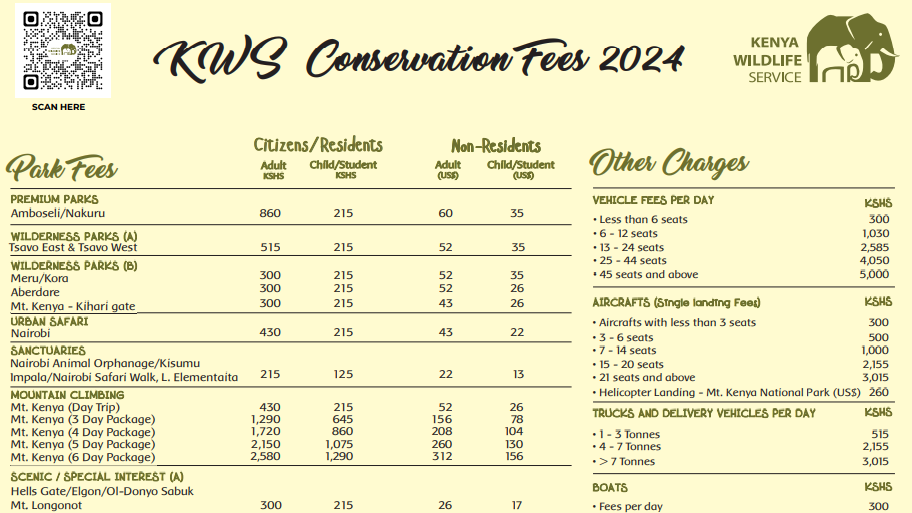
Below is a PDF Document released by KWS on the new Park Entry fees for all parks, reserves, sanctuaries, marine parks. Both Tsavo West NP and Tsavo East NP are on the schedule in the document under Wilderness Parks A.
Who qualifies for each Tsavo fee category?
Your Tsavo entry fee depends less on where you are entering and more on who you are under the KWS fee categories. The main categories are East African citizen, resident, African citizen, and non-resident. KWS regulations define a resident as a person other than a Kenyan citizen or East African citizen who resides in Kenya with a valid resident permit, while a non-resident is a national of a country outside the East African citizen and African citizen categories.
| Category | Who it generally applies to | Proof usually needed |
|---|---|---|
| East African citizen | Kenyan citizens and citizens of East African Community countries | National ID for Kenyan citizens or valid passport for other East African citizens |
| Kenya resident | Non-citizens legally residing in Kenya | Valid residence permit |
| African citizen | Citizens of African countries outside the East African citizen category | Valid passport |
| Non-resident | International visitors outside the East African citizen and African citizen categories | Valid passport |
1️⃣ Current Tsavo East & West Parks Entrance Fees (2026)
Under the new KWS tariff, Tsavo East and Tsavo West are both classified as Wilderness A Parks, sharing the same rate structure.
🚶 Citizens & Residents (Kenyan and East African Citizens)
How much do Kenyan citizens & East African Citizens pay to enter Tsavo?
East Africans Citizens including Kenyan citizens pay KES 1,000 per adult and KES 500 per child or student to enter Tsavo East National Park or Tsavo West National Park. KWS lists Kenyan citizens under the East African citizen fee category, and the same fee applies to both Tsavo parks.
| Kenyan citizen category | Tsavo East | Tsavo West |
|---|---|---|
| Adult | KES 1,000 | KES 1,000 |
| Child/student | KES 500 | KES 500 |
East African Citizens from 8 countries that make up the East African Community including Kenyan citizens should carry a valid national ID, passport, or accepted identification when entering the park because the visitor category may be checked at the gate.
| Category | Adults (KES) | Children / Students (KES) |
|---|---|---|
| Wilderness Parks (A) – Tsavo East & Tsavo West | 1,000 | 500 |
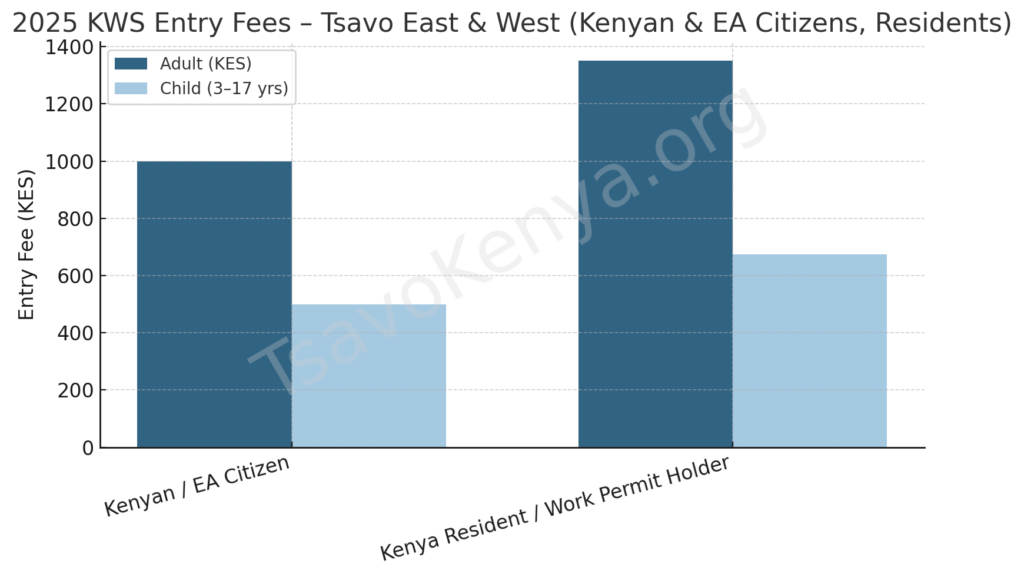
Kenyan citizens are included under the East African citizen category, so they pay the same Tsavo rate as other qualifying East African citizens: KES 1,000 per adult and KES 500 per child or student.
Other East African citizens should carry a valid passport or accepted national identification document showing their nationality when using the East African citizen rate.
🏠 Kenya Residents (Foreign Nationals Residing in Kenya)
Tsavo entrance fees for Kenya residents is KES 1,350 per adult and KES 675 per child or student as shown in summary table below:
| Category | Adults (KES) | Children / Students (KES) |
|---|---|---|
| Wilderness Parks (A) – Tsavo East & Tsavo West | 1,350 | 675 |
To prove resident status for Tsavo park entry, visitors should carry a valid resident permit or official residence document matching the details used when buying the ticket. KWS guidelines define a resident as a person residing in Kenya with a valid resident permit.
Useful documents may include:
- Valid resident permit
- Work permit or dependant pass, where applicable
- Passport matching the residence document
- Student identification, if using a student ticket
- Digital ticket or payment confirmation
The name and identification details should match the ticket category selected during purchase.
A foreigner living in Kenya can pay the Kenya resident rate if they have a valid resident permit. For Tsavo East and Tsavo West, this rate is KES 1,350 per adult and KES 675 per child or student. A tourist visa does not normally qualify a visitor for the Kenya resident rate.
The difference is that citizen fees apply to East African citizens, while resident fees apply to non-citizens who live in Kenya with a valid resident permit. For Tsavo, East African citizen adults pay KES 1,000, while Kenya resident adults pay KES 1,350. Children and students pay KES 500 under the East African citizen category and KES 675 under the resident category.
| Category | Adult fee | Child/student fee |
|---|---|---|
| East African citizen | KES 1,000 | KES 500 |
| Kenya resident | KES 1,350 | KES 675 |
A Kenyan citizen should not select the resident category. A foreigner living in Kenya should not select the citizen category unless they are also an East African citizen.
🌍 Non-Residents (Tourists from Outside Africa)
Foreign visitors who fall under the non-resident category pay USD 80 per adult and USD 40 per child or student to enter Tsavo East National Park or Tsavo West National Park. KWS lists Tsavo East and Tsavo West together under the wilderness parks category, with non-resident rates of USD 80 adult and USD 40 child/student.
| Category | Adults (USD) | Children / Students (USD) |
|---|---|---|
| Wilderness Parks (A) – Tsavo East & Tsavo West | 80 | 40 |
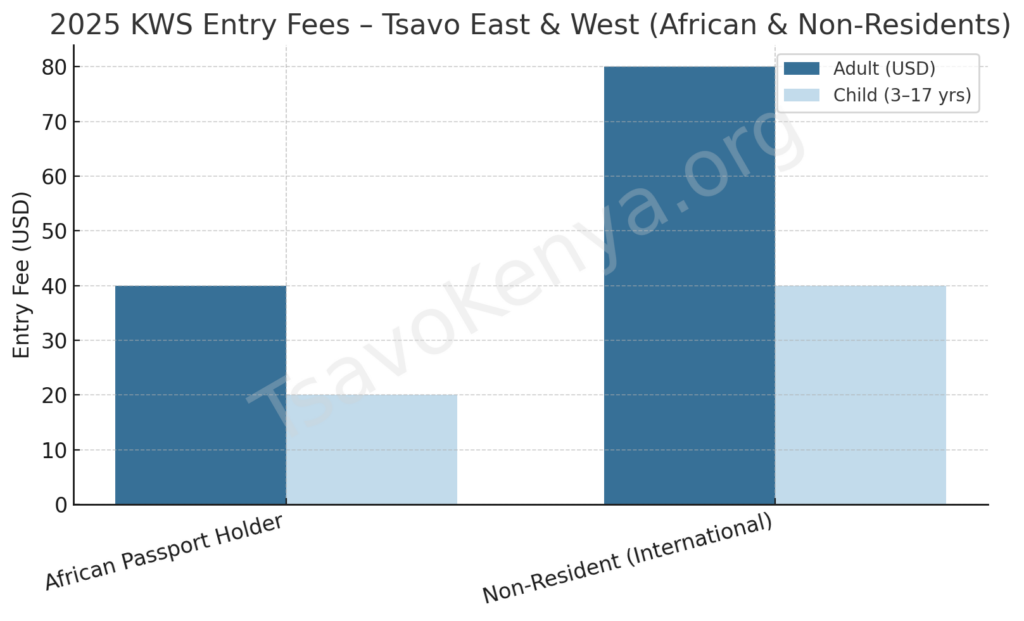
This is the personal conservation fee only. It does not include vehicle entry charges, safari vehicle hire, guide fees, accommodation, meals, camping, transfers, or special activities. Non-resident rates are paid in USD, unlike East African and Citizen rates paid in Kenya Shillings.
Tsavo fees are higher for international visitors and allows lower local access rates while international visitors contribute a higher conservation fee toward park management, wildlife protection, roads, ranger operations, and visitor infrastructure.
The African citizen fee applies to nationals of African countries outside the East African citizen category, while the non-resident fee applies to international visitors who do not qualify as East African citizens, Kenya residents, or African citizens. For Tsavo, African citizen adults pay USD 40, while non-resident adults pay USD 80.
| Category | Adult fee | Child/student fee |
|---|---|---|
| African citizen | USD 40 | USD 20 |
| Non-resident | USD 80 | USD 40 |
Visitors using the African citizen category should carry a valid African passport for verification.
🌍 African Citizens (Non-EAC)
| Category | Adults (USD) | Children / Students (USD) |
|---|---|---|
| Wilderness Parks (A) – Tsavo East & Tsavo West | 40 | 20 |
African citizens do not pay the same as non-residents. For Tsavo East and Tsavo West, African citizen adults pay USD 40, while non-resident adults pay USD 80. African citizen children/students pay USD 20, while non-resident children/students pay USD 40.
KWS defines African citizen as a national of an African country other than East African countries.
💡 Note:
- Children are classified as those aged 3–17 years.
- Students must present a valid institutional letter and receive KWS approval for educational trips.
- Children under 5 years old enter free.
- Fees apply per 24-hour visit window.
2️⃣ Tsavo East & West National Parks Entrance Fees for Children (Ages 5–17) – 2026
Children’s entry fees at Tsavo East and West follow the same 2026 KWS schedule, based on nationality and residency category.
| Category | High Season (July–March) | Low Season (April–June) |
|---|---|---|
| Citizen Child (Ages 5–17) | 500 KES | 500 KES (No seasonal change) |
| Resident Child (Ages 5–17) | 675 KES | 675 KES |
| African Citizen Child (Ages 5–17) | 20 USD | 20 USD |
| Non-Resident Child (Ages 5–17) | 40 USD | 40 USD |
The Tsavo student entry fee is the same as the child/student rate: KES 500 for East African citizens, KES 675 for Kenya residents, USD 40 for non-residents, and USD 20 for African citizens. The same student fee applies to both Tsavo East and Tsavo West.
A KWS student is an individual not older than 23 years from a recognized secondary school, college, or university who is visiting for educational purposes under a documented and organized arrangement with that institution. This means a school, college, or university trip must be formally organized and documented to qualify for the student rate.
A young adult with a student ID does not automatically qualify if the visit is a private holiday rather than an organized educational visit. The institution, purpose of visit, and supporting documents matter.
Student-rate visitors should carry documents that prove both student status and the educational purpose of the trip. KWS defines qualifying students as learners from recognized education institutions visiting under a documented and organized arrangement, so schools should prepare official documentation before travel.
Useful documents may include:
- Official school, college, or university letter
- Student list or manifest
- Student IDs where available
- Identification documents or passports
- Proof of age for children
- Booking confirmation or KWS ticket receipt
- Teacher or institution contact details
Teachers and accompanying adults should generally be budgeted under the relevant adult visitor category, not the student category. The KWS student definition refers to individuals from recognized education institutions visiting for educational purposes, with an age limit of not older than 23 years.
For a Tsavo school trip, teachers may therefore need to be calculated as East African citizen adults, Kenya resident adults, African citizen adults, or non-resident adults, depending on their status. The adult fee is KES 1,000, KES 1,350, USD 40, or USD 80 depending on category.
💡 Important Notes:
✔ Children under 5 years old enter free of charge.
✔ Educational groups qualify for discounted educational rates with prior KWS approval.
✔ Rates apply for a 24-hour stay, regardless of time of entry.
3️⃣ Additional Fees & Activities at Tsavo East & West
The 2025/26 revision harmonized charges for camping, guided activities, and vehicle entry across all major KWS parks.
| Activity / Service | East African Citizens | Kenya Residents | African Citizens | Non-Residents |
|---|---|---|---|---|
| Public Campsite | 200 / 150 (Adult/Child) | 300 / 200 | 10 / 8 (USD) | 20 / 15 (USD) |
| Special Campsite | 250 / 200 | 350 / 250 | 20 / 10 (USD) | 35 / 20 (USD) |
| Night Game Drive | 3,000 | 3,000 | 50 (USD) | 50 (USD) |
| Walking Safari (Guided) | 3,000 | 3,000 | 50 (USD) | 50 (USD) |
| Guided Tour (Up to 4 hrs) | 2,000 | 2,000 | 25 (USD) | 25 (USD) |
| Guided Tour (Over 4 hrs) | 4,000 | 4,000 | 40 (USD) | 40 (USD) |
| Overnight Rhino Viewing (Tsavo West) | 3,000 | USD 35 | USD 35 | USD 70 |
4️⃣ Vehicle Entry Fees
| Vehicle Type | Rate (KES) | Notes |
|---|---|---|
| Private Vehicle (≤6 seats) | 600 | Charged per vehicle per 24 hours. |
| Tour Van / Minibus (6–12 seats) | 1,500 | Standard safari van. |
| Tour Bus (13–24 seats) | 3,000 | Applies to small groups. |
| Tour Bus (25–44 seats) | 4,500 | Medium groups. |
| Tour Bus (45+ seats) | 5,000 | Large organized or school groups. |
Vehicle entry charges are daily entry fee paid to drive in the Parks per day. The fee is based on seating capacity, with rates from KES 600 for vehicles with fewer than 6 seats to KES 5,000 for vehicles with 45 seats and above.
This matters for overnight trips because the vehicle fee may apply for each day the vehicle is inside the park, depending on the ticket and itinerary structure selected during payment.
Self-drive visitors pay personal park entry fees for each visitor and a separate vehicle entry fee for the car. Tsavo personal entry fees are listed by visitor category, while vehicle charges are listed separately by number of seats.
For self-drive budgeting, calculate the cost in this order:
- Visitor entry fees for every adult, child, or student
- Vehicle charge based on seat capacity
- Fuel and road costs
- Guide cost, if hiring one
- Camping or accommodation, if staying overnight
- Food, water, and emergency buffer
The self-drive cost for Tsavo depends on your visitor category, number of passengers, vehicle size, fuel, route, accommodation, and whether you hire a guide. At minimum, self-drive visitors pay the KWS personal entry fees plus the KWS vehicle fee. For example, a 6–12 seat vehicle pays KES 1,500 per day, while each non-resident adult pays USD 80 for park entry.
A basic one-day self-drive cost could look like this:
| Example group | Personal entry fees | Vehicle fee | KWS total before other costs |
|---|---|---|---|
| 2 East African citizen adults in a small car | KES 2,000 | KES 600 | KES 2,600 |
| 4 East African citizen adults in a Land Cruiser | KES 4,000 | KES 1,500 | KES 5,500 |
| 2 non-resident adults in a Land Cruiser | USD 160 | KES 1,500 | USD 160 + KES 1,500 |
Tsavo vehicle entry fees vary by number of seats, so a small private car, safari van, Land Cruiser, minibus, school bus, and large coach can fall into different fee categories. KWS lists KES 600 for fewer than 6 seats, KES 1,500 for 6–12 seats, KES 3,000 for 13–24 seats, KES 4,500 for 25–44 seats, and KES 5,000 for 45 seats and above.
The vehicle charge is therefore especially important for school trips, overland trucks, large group tours, and operators using high-capacity v
5️⃣ Who Is Exempt from Paying Tsavo East and Tsavo West Park Fees (2026)
Under the 2026 KWS Conservation Fee Regulations, certain individuals and groups continue to qualify for free or discounted entry to Tsavo East and Tsavo West National Parks. While the new tariff structure introduced updated park categories and digital payment enforcement through KWSPay, these exemptions remain consistent with KWS’s conservation and educational access policies.
✔ Children Under 5 Years – Enjoy free entry to all KWS-managed parks.
✔ KWS Staff & Official Government Guests – Exempted from fees upon presentation of valid identification or authorization letters.
✔ Registered Tour Guides – Must hold a valid Tour Guide License issued by the Tourism Regulatory Authority (TRA).
✔ Students on Official Educational Trips – Granted discounted entry or free access when trips are pre-approved by KWS and accompanied by an official institutional letter.
💡 Expert Tip: Always carry your valid identification, permit, or authorization letter when entering the park to ensure smooth access. Even exempt visitors must be registered digitally via KWSPay for park security and visitor tracking compliance.
6️⃣ Best Time to Visit Tsavo East and Tsavo West (Based on Fees & Seasons)
Under the 2025/26 KWS tariff, Tsavo East and Tsavo West maintain flat entry rates throughout the year — there are no longer separate “high” or “low” season park fees. This means your choice of visit depends entirely on wildlife conditions, weather, and visitor traffic, not ticket price fluctuations.
✔ Dry Season (June–October & January–February) – Considered the best time for wildlife viewing, as animals congregate around permanent water sources like Athi-Galana River, Aruba Dam, and Mzima Springs. Roads are drier and easier to access.
✔ Green/Wet Season (March–May & November–December) – Offers lush landscapes, fewer tourists, and lower accommodation rates. Some roads, especially in Tsavo East’s southern sections, may become muddy or temporarily impassable, adding a sense of off-road adventure.
💡 Travel Tip: For budget-conscious travelers, visiting outside major holiday months (August and December) helps reduce overall safari costs, since park fees remain constant but lodging and vehicle hire prices fluctuate seasonally.
Even with the new fee adjustments (KES 1,000–1,350 for locals; USD 80 for non-residents), Tsavo remains one of Kenya’s best-value safari destinations, offering immense landscapes, fewer crowds, and timeless wilderness experiences year-round.
Tsavo ticket validity: how long does a park ticket last?
The KWS fee regulations define a daily fee as a fee payable for a single access to a national park, national reserve, or sanctuary, valid for a period not exceeding 24 hours.
For visitors, this means a Tsavo ticket should be treated as a date-specific access document, not an open-ended pass. If you are staying overnight inside the park, moving between parks, or entering on one date and exiting on another, confirm the correct ticket structure before paying.
Does one Tsavo ticket cover both Tsavo East and Tsavo West?
Do not assume a single-park ticket for Tsavo East automatically covers Tsavo West, or the reverse. Tsavo East and Tsavo West are separate national parks, even though their standard entry fees are the same. If your itinerary crosses from one park to another, select the correct park combination or package when paying.
KWS guidelines say package tickets apply only to visitor entry fees, are valid only if payment for all selected parks is made at once, and are applicable for a continuous stay only. They are also specific to selected dates and parks.
What is included in the Tsavo park entry fee?
The Tsavo park entry fee covers visitor access to the selected national park for the ticketed date and visitor category. It is a conservation or access fee paid to KWS for entry into Tsavo East or Tsavo West. It does not normally include a private safari vehicle, fuel, driver-guide, vehicle entry fee, accommodation, food, camping fees, special activities, or transfers.
For example, KWS lists vehicle charges per day separately from the personal entry fee, with charges ranging from KES 600 for vehicles with fewer than 6 seats to KES 5,000 for vehicles with 45 seats and above.
Are Tsavo fees paid in Kenya shillings or US dollars?
Tsavo fees are paid in Kenya shillings for East African citizens and Kenya residents, and in US dollars for non-residents and African citizens. KWS lists Tsavo East and Tsavo West fees by currency category: East African citizen and resident rates are shown in KSH, while non-resident and African citizen rates are shown in USD.
Payment is made through eCitizen/KWSPay, and KWS states that payment can be made via M-Pesa or Visa card.
Are Tsavo park entry fees charged per person or per vehicle?
Tsavo park entry fees are charged per person, based on the visitor’s category and age or student status. Vehicles are charged separately under the KWS vehicle fee schedule. For example, the personal adult fee for a non-resident is USD 80, while a standard 6–12 seat vehicle is charged separately at KES 1,500 per day.
This means a private safari group usually has two KWS cost layers: visitor entry fees and a vehicle entry charge.
Tsavo package fees with Amboseli
KWS lists special package rates for visitors combining Tsavo with Amboseli. These package rates can matter for longer safaris that connect Tsavo West and Amboseli, or Tsavo East, Tsavo West, and Amboseli.
Adult package rates
| Package | East African citizen | Resident | African citizen | Non-resident |
|---|---|---|---|---|
| Tsavo West + Amboseli | KES 2,200 | KES 2,900 | USD 80 | USD 150 |
| Tsavo East + Tsavo West + Amboseli | KES 3,000 | KES 4,000 | USD 115 | USD 215 |

Child/student package rates
| Package | East African citizen | Resident | African citizen | Non-resident |
|---|---|---|---|---|
| Tsavo West + Amboseli | KES 1,100 | KES 1,550 | USD 45 | USD 80 |
| Tsavo East + Tsavo West + Amboseli | KES 1,500 | KES 2,150 | USD 60 | USD 115 |

The official fee schedule lists both adult and child/student package rates for these Tsavo-Amboseli combinations.
Package tickets need careful handling. KWS guidelines state that package tickets apply only to visitor entry fees, payment for all selected parks must be made at once, the package applies to a continuous stay only, and if one park in the package is cancelled, package rates cease to apply. The same guidelines state that no refund is issued in case of cancellation for any park, package tickets are visitor-specific and not transferable, and partially used package tickets are non-refundable and cannot be rescheduled.
Tsavo Camping Fees
Camping fees are separate from normal park entry. A visitor camping in Tsavo should budget for park entry fees, camping fees, and possibly special campsite reservation fees.
Because Tsavo is not Amboseli or Lake Nakuru, it falls under the All Other Parks camping-fee row in the KWS schedule.
| Camping type | East African citizen | Resident | African citizen | Non-resident |
|---|---|---|---|---|
| Private campsite adult | KES 250 | KES 350 | USD 20 | USD 35 |
| Private campsite child/student | KES 200 | KES 250 | USD 10 | USD 20 |
| Public campsite adult | KES 200 | KES 300 | USD 10 | USD 20 |
| Public campsite child/student | KES 150 | KES 200 | USD 8 | USD 15 |
The KWS fee regulations also list a KES 10,000 special campsite reservation fee per week, marked as non-refundable.
Public campsites are usually simpler and less exclusive, while special or private campsites require more planning, equipment, water, food, and advance coordination. KWS’s Tsavo East page notes that public campsites provide standard amenities such as water, toilet/bathroom, and kitchen area, while special campsites provide only camping grounds and require advance reservation.
Tsavo guided tour and security guide fees
KWS lists a security/guided tour per guide at KES 2,000 for up to 4 hours and KES 4,000 for over 4 hours on both Tsavo East and Tsavo West official pages.
This is not the same as hiring a private safari driver-guide from a tour company. A tour company’s driver-guide fee may be included in the safari package price, while the KWS security/guided tour fee is a specific KWS service charge. Visitors should check whether their quoted safari price includes only the private driver-guide, or whether it also covers any KWS special guide/security requirement.
Tsavo gate fees: do different gates charge different entry fees?
The visitor entry fee is not higher or lower because of the gate. The fee depends on the park selected, visitor category, age/student status, vehicle size, and ticket type. However, the gate you choose affects route planning, fuel, time, and which attractions are realistic for that day.
For Tsavo West, KWS lists gates including Tsavo, Lake Jipe, Mtito Andei, Chyulu, Maktau, and Ziwani. It also notes that visitors from Nairobi commonly use Mtito Andei, visitors from Amboseli can use Chyulu Gate, visitors from Mombasa may use Tsavo Gate near Manyani, and visitors on the Taveta–Voi route may use Maktau, Ziwani, and Jipe gates.
For Tsavo East, KWS notes road access through Mtito Andei Gate on the Nairobi–Mombasa Road and access from Malindi through Sala Gate. Its official page also lists several airstrips, including Voi, Aruba, Satao, Sala, Ithumba, Sangayaya, Mopeo, Bachuma, and Cottars.
Can I pay Tsavo East entry fees at the gate?
Tsavo East entry fees are paid through eCitizen/KWSPay, with KWS listing M-Pesa and Visa card as payment options. The gate is used for verification and entry processing, so visitors should prepare their online ticket, payment confirmation, ID, passport, or resident permit before arrival. While payment at the main gates such as Voi Gate using card and MPesa are still possible, KWS discourages it as it seeks to get everyone to make payments online and limit quees building up during peak park entry periods in the morning. Payment at the gate should be considered only as last resort if your card payment isn’t going through. If you plan to pay at the gate, please be there early to avoid crowds especially during peak tourist season.
Refunds, changes, and ticket mistakes
Tsavo park tickets are date-specific, park-specific, and visitor-specific. When you purchase a KWS park entry ticket, the ticket states at the bottom that it is non-refundable, non-transferable, and cannot be rescheduled. This applies to both single-park tickets and multi-park package tickets.
KWS may sometimes assist with correcting genuine errors, such as changing a wrong park entry date, but this is not guaranteed. Refunds are much stricter and should not be expected once payment has been made. Visitors should confirm the correct park, visit date, visitor category, names, ID or passport details, and vehicle information before buying a Tsavo ticket.
For ordinary single-park visits, the safest approach is to confirm these details before paying:
- Correct park: Tsavo East, Tsavo West, or package
- Correct date
- Correct visitor category
- Correct adult/child/student status
- Correct passport, ID, or resident permit details
- Correct vehicle category
- Correct number of guests
Small mistakes may take time to correct, and refunds should not be assumed. Pay only after your itinerary is reasonably firm.
Important Park Entry and Ticket Purchase Rules
- KWS park entry tickets are issued for either Tsavo East or Tsavo West Parks for specific date, visitor category, and visitor details. Unless they are packages that combine more than one park the ticket admission are only applicable to the Park you’ve purchased the ticket for.
- When you purchase a KWS park entry ticket, the ticket states that it is non-refundable, non-transferable, and cannot be rescheduled.
- Visitors should confirm the correct park, visit date, names, ID or passport details, visitor category, and vehicle details before payment.
- Ticket corrections may be difficult after payment, especially where the wrong date, wrong park, or wrong visitor category has been selected.
- Card payments may attract a percentage handling fee depending on the card issuer or bank. There is $1 access fee for USD payments or Kes. 100 for Kenya Shillings payments. These additional access fee are added to the final bill you get.
- Visitors must carry the identification document used to qualify for the selected fee category, such as a national ID, passport, resident permit, student ID, or disability identification where applicable.
- National parks are plastic-free zones, and single-use plastic is prohibited.
- Park gates generally open at 6:00 AM and close at 6:00 PM, unless visitors are staying overnight inside the park.
- Visitors enter the park at their own risk, and park terms and conditions apply.
- General road rules apply inside the park, including no hooting and no driving under the influence of alcohol.
- The maximum speed limit inside the park is 40 km/h / 25 mph, and speeding may attract penalties.
- Visitors must stay on established roads and tracks, as off-road driving is strictly prohibited.
- Visitors must remain inside the vehicle except in designated areas.
- Vehicle doors should remain closed when viewing wildlife.
- Wildlife must be viewed from a minimum distance of 20 metres.
- Visitors should move slowly and quietly because animals can react dangerously when startled.
- Noise should be kept to a minimum, and mobile phones or sound devices should be used sparingly and only in appropriate areas.
- Feeding wildlife is prohibited because it disrupts natural feeding behaviour and can make animals dependent on people.
- All litter must be carried out of the park to keep the environment clean.
- Campfires must not be left unattended while camping.
- Visitors are in a wildlife habitat and must respect animals’ privacy, space, and right of way.
💳 How to Pay for Tsavo Park Entry via KWSPay
All KWS park entry fees are paid online only through KWSPay, the official eCitizen subdomain for park payments. Cash payments are not accepted at park gates.
Step-by-Step:
- Visit the KWSPay link for your preferred park:
- Log in or create an eCitizen account.
- Enter your details — visitor names, nationality, entry and exit dates, and gate of entry (Voi, Manyani, Buchuma, Mtito Andei, Chyulu, etc.).
- Add vehicle details and select activities like camping or guided tours.
- Pay using MPesa, Visa/MasterCard, or eCitizen Wallet.
- Download and save your receipt (with QR code) and present it at the gate with your valid ID or passport.
Expert Tip: If the page appears blank or unresponsive, wait 2–3 minutes before refreshing. Never pay anyone in cash or outside eCitizen. For assistance, contact customerservice@kws.go.ke or call 0800 597000.
⚖️ Court Suspension & Refund Guidance
On October 2, 2025, the High Court issued a temporary injunction halting the enforcement of the new KWS fees following a petition by the Kenya Tourism Federation (KTF).
- The court hearing is scheduled for November 25, 2025.
- Despite the injunction, KWSPay continues to charge the new rates, and KWS has directed all visitors to proceed with payment.
- Should the court later invalidate the new tariff, visitors can request a refund by emailing customerservice@kws.go.ke with their payment receipt attached.
📊 Old vs New Fees for Tsavo East & West
| Visitor Category | 2023/24 Rate | 2026 Rate | % Increase | Commentary |
|---|---|---|---|---|
| East African Citizen (Adult) | KES 430 | KES 1,000 | +133% | Aligns with conservation cost realities; still affordable for domestic visitors. |
| Kenya Resident (Adult) | KES 515 | KES 1,350 | +162% | Reflects inflation correction and park infrastructure costs. |
| African Citizen (non-EAC) | — | USD 40 | New Category | Encourages intra-African tourism. |
| Non-Resident (Adult) | USD 43 | USD 80 | +86% | Brings Tsavo closer to regional standards but remains far cheaper than Serengeti (USD 150) and Masai Mara (USD 200 peak). |
Insight: The 2025 increase modernizes pricing after nearly 20 years of stagnation, ensuring Tsavo’s conservation programs are adequately funded while keeping the parks regionally competitive and accessible for domestic and African visitors.
🌍 Why the New Fees Matter for Conservation
The Tsavo ecosystem faces growing challenges — from rising climate pressures and drought, to poaching threats and infrastructure strain. The 2025 tariff is part of KWS’s long-term Conservation Funding Strategy, which seeks to:
- Reinforce ranger operations and patrol logistics.
- Maintain over 3,000 km of park roads and water points.
- Improve visitor facilities and gate infrastructure.
- Support community-based conservation around Tsavo’s buffer zones.
💡 How Tsavo Compares to Other Parks
| Park / Reserve | Non-Resident Adult (USD) | Status |
|---|---|---|
| Masai Mara National Reserve | 200 (Peak) / 100 (Low) | County-managed premium reserve |
| Amboseli National Park | 90 | KWS premium park |
| Lake Nakuru National Park | 90 | KWS premium park |
| Tsavo East / Tsavo West | 80 | Wilderness A (KWS) |
| Hell’s Gate National Park | 50 | Scenic & Adventure park |
Even with the new rates, Tsavo remains one of Kenya’s most affordable premier wildlife destinations, offering vast wilderness experiences and exceptional value for money.
Why Tsavo East Should Command Higher Park Fees Than Tsavo West
While both parks are part of the same ecosystem, Tsavo East offers a distinctly superior safari experience, and its value arguably warrants a higher entry fee than Tsavo West. Treating both as equal under the 2025 KWS tariff overlooks key differences in wildlife density, accessibility, visitor experience, and conservation costs.
1️⃣ Superior Wildlife Viewing
Tsavo East consistently delivers better wildlife visibility and higher game densities. Its open savannahs and permanent water sources—Galana River, Aruba Dam, and Mudanda Rock—create ideal conditions for viewing elephants, buffalo, lions, and cheetahs in large numbers. Tsavo West, though scenic, is more wooded and volcanic, making animal sightings less frequent.
2️⃣ Easier Accessibility
Tsavo East’s Voi and Bachuma gates sit right off the Nairobi–Mombasa Highway, making it far more accessible for both domestic and coastal tourists. Travel time from Mombasa averages just 2–3 hours, with relatively well-maintained internal roads leading to major attractions. Tsavo West’s rugged terrain, by contrast, appeals more to seasoned adventurers than first-time visitors.
3️⃣ More Iconic Landmarks
Tsavo East boasts Kenya’s most recognizable natural features—the Yatta Plateau, Mudanda Rock, and Lugard Falls—alongside thriving elephant herds along the Galana River. Tsavo West’s Mzima Springs and Shetani Lava Flow are impressive but less diverse. Tsavo East’s scale and photo-rich landscapes provide a stronger international draw deserving of premium pricing.
4️⃣ Greater Conservation Needs
At 13,747 km², Tsavo East is 50% larger than Tsavo West, demanding far greater resources for anti-poaching, ranger patrols, and infrastructure upkeep. Its vastness and history of elephant poaching mean that maintaining ecological balance and security comes at higher cost.
📊 Expert View:
Given its scale, wildlife richness, visitor appeal, and management costs, Tsavo East fits the profile of a Premium Wilderness Park, much like Amboseli or Lake Nakuru. A differentiated pricing model—charging slightly more for Tsavo East—would better reflect its true ecological and tourism value, while channeling additional funds toward its long-term conservation.
✅ Key Takeaways
- New rates (effective October 1, 2025): KES 1,000–1,350 (East Africans/Residents), USD 80 (Non-Residents).
- Applies to both Tsavo East and Tsavo West National Parks.
- Children pay 50%, and under 5s enter free.
- All payments online via KWSPay (eCitizen).
- Court case pending November 25, 2025 — refunds available if rates are nullified.
- Tsavo remains cheaper than the Mara and Serengeti, yet among the best-value safari experiences in Africa.
Tsavo East & Tsavo West National Park Entry Fees – Comprehensive FAQs
⚖️ 1. What are the new 2025 entry fees for Tsavo East and Tsavo West National Parks?
Under the 2025 Wildlife Conservation and Management (Access and Conservation) Regulations, both Tsavo East and Tsavo West are classified as Wilderness A Parks with harmonized entry fees per 24-hour visit:
| Visitor Category | Adult | Child (3–17 years) |
|---|---|---|
| East African Citizens | KES 1,000 | KES 500 |
| Kenya Residents | KES 1,350 | KES 675 |
| African Citizens (non-EAC) | USD 40 | USD 20 |
| Non-Residents (International Visitors) | USD 80 | USD 40 |
Children under 5 years enter free.
🧾 2. When did the new park fees take effect?
The new tariff was gazetted in late September 2025 and officially took effect on October 1, 2025 under the Wildlife Conservation and Management (Access and Conservation) (Fees) Regulations, 2025.
However, enforcement was temporarily halted on October 2, 2025 by a High Court order, pending a judicial review scheduled for November 25, 2025.
⚖️ 3. Why is there a court case about the new KWS park fees?
The Kenya Tourism Federation (KTF) filed a petition claiming that the 2025 fee changes were implemented without adequate consultation and with short notice, causing disruptions to pre-booked safaris and tour contracts.
The High Court issued a temporary injunction pausing enforcement until the matter is heard and determined.
💰 4. Which rates are currently being charged at Tsavo East and West gates?
Despite the court suspension, KWSPay (the eCitizen payment portal) continues to display and charge the new 2025 rates, as the system has not reverted to the previous 2022/2023 schedule.
KWS has advised that all visitors should proceed with payment at the displayed rates, and if the court later overturns the new tariff, affected guests can request refunds via customerservice@kws.go.ke with a copy of their payment receipt.
🧭 5. How can I pay for park entry to Tsavo East or Tsavo West?
All park entry fees are paid online only through KWSPay, a subdomain of eCitizen.
No cash payments are accepted at park gates.
Steps to pay:
- Visit the official KWSPay link above
- Log in or create an eCitizen account.
- Fill in visitor names, gate of entry, nationality, dates, and vehicle details.
- Add optional activities (e.g., camping, walking safari).
- Pay via MPesa, Visa/MasterCard, or eCitizen Wallet.
- Download your QR-coded receipt and present it at the park gate with your ID or passport.
⏳ 6. What should I do if the KWSPay page doesn’t load or seems stuck?
KWSPay sometimes experiences slow loading or blank screens during peak usage.
- Wait 2–3 minutes before refreshing.
- Avoid double-clicking or restarting payment to prevent duplicate transactions.
- Check your eCitizen “My Applications” section for confirmation.
- If the issue persists, contact customerservice@kws.go.ke or call 0800 597000.
Never pay anyone in cash or outside eCitizen.
🧒 7. Do children pay to enter Tsavo East or Tsavo West?
Yes.
- Children aged 3–17 years pay half the adult rate.
- Children under 5 years enter free.
This applies across all visitor categories.
🌍 8. What are the differences between the 2022/2023 and 2025 fees?
| Category | 2022/23 (Old) | 2025 (New) | % Increase |
|---|---|---|---|
| East African Citizen (Adult) | KES 430 | KES 1,000 | +133% |
| Kenya Resident (Adult) | KES 515 | KES 1,350 | +162% |
| Non-Resident (Adult) | USD 43 | USD 80 | +86% |
The 2025 update brings Tsavo’s pricing in line with regional norms after nearly 20 years of stability, ensuring sustainable conservation funding while keeping the parks affordable for East Africans and cheaper than Serengeti (USD 150) or Masai Mara (USD 200 peak).
🏕️ 9. How much are camping and activity fees in Tsavo?
| Activity / Service | East African Citizens | Residents | African Citizens | Non-Residents |
|---|---|---|---|---|
| Public Campsite | KES 200 / 150 | KES 300 / 200 | USD 10 / 8 | USD 20 / 15 |
| Special Campsite | KES 250 / 200 | KES 350 / 250 | USD 20 / 10 | USD 35 / 20 |
| Night Game Drive | KES 3,000 | KES 3,000 | USD 50 | USD 50 |
| Guided Tour (4 hrs) | KES 2,000 | KES 2,000 | USD 25 | USD 25 |
| Walking Safari | KES 3,000 | KES 3,000 | USD 50 | USD 50 |
| Overnight Rhino Viewing (Tsavo West) | KES 3,000 | USD 35 | USD 35 | USD 70 |
🚐 10. What are the current vehicle entry fees?
| Vehicle Type | Rate (KES) | Notes |
|---|---|---|
| Private vehicle (≤6 seats) | 600 | Per vehicle. |
| Tour van/minibus (6–12 seats) | 1,500 | Common for safaris. |
| Tour bus (13–24 seats) | 3,000 | Medium groups. |
| 25–44 seats | 4,500 | Larger organized groups. |
| Over 45 seats | 5,000 | School or expedition vehicles. |
🏞️ 11. What is the difference between Tsavo East and Tsavo West?
- Tsavo East is larger (13,700 km²) and known for its open savannahs, red elephants, and the Yatta Plateau.
- Tsavo West is smaller but more scenic (9,000 km²), featuring Mzima Springs, Shetani lava flows, rhino sanctuary, and volcanic landscapes.
Both parks charge the same entry fees under the 2025 regulations.
🕐 12. How long does a park entry ticket remain valid?
All park entry tickets are valid for 24 hours from the time of entry.
Visitors exceeding this duration will need to pay for an additional 24-hour period.
🌐 13. Can I pay on arrival at the park gate?
You should plan to pay online unless you have an issue with your card payment not going through. In that case, you’ll get help at the gate and they’ll use the manual card reader to process the payment.
All KWS parks require advance payment through eCitizen (KWSPay) before entry. Park gates are cashless and will only allow entry after your digital receipt is verified.
💸 14. Can I get a refund if the court cancels the 2025 park fees?
Yes.
If the High Court invalidates the 2025 rates, visitors who paid the new fees can request refunds by emailing customerservice@kws.go.ke with:
- A copy of the payment receipt.
- The eCitizen transaction reference number.
Refunds will be processed directly by KWS.
🛡️ 15. Why are KWS park fees increasing now?
KWS notes that entry fees have remained largely unchanged since 2007, while the cost of ranger operations, infrastructure, and anti-poaching patrols has increased sharply.
The 2025 adjustment is meant to:
- Fund wildlife protection and park maintenance.
- Improve visitor infrastructure and digital systems.
- Align Kenya’s pricing with regional conservation models.
🦁 16. Are Tsavo East and West still cheaper than other major parks?
Yes.
Even after the 2025 increases, Tsavo remains more affordable than the Masai Mara (USD 200 peak season) or Serengeti (USD 150).
This keeps Tsavo among the best-value safari destinations in East Africa, especially for multi-day safaris and domestic travelers.
📆 17. What happens after the November 2025 court ruling?
If the court upholds the 2025 regulations, the new rates will become fully enforceable nationwide.
If it quashes the regulation, KWS will revert to the 2022/23 rates, and visitors who paid the higher fees can seek refunds.
Either way, the KWSPay platform will update automatically.
💡 18. Why are there differences between “East African Citizens” and “Kenya Residents”?
- East African Citizens are nationals of EAC member countries (Kenya, Uganda, Tanzania, Rwanda, Burundi, South Sudan).
- Kenya Residents are foreign nationals legally living in Kenya on valid permits.
Residents pay higher fees than EAC citizens but lower than non-residents.
🧳 19. What documents do I need to show at the park gate?
Visitors must present:
- A valid ID or passport (to confirm nationality).
- A printed or digital eCitizen receipt with QR code.
- A vehicle logbook or registration if self-driving.
🧠 20. How do Tsavo’s 2025 rates compare regionally?
| Destination | Non-Resident Adult (USD) | Notes |
|---|---|---|
| Tsavo East/West (Kenya) | 80 | Wilderness category |
| Amboseli (Kenya) | 90 | Premium KWS park |
| Lake Nakuru (Kenya) | 90 | Premium KWS park |
| Masai Mara (Kenya) | 200 (peak) | County-managed |
| Serengeti (Tanzania) | 150 | TANAPA premium park |
Tsavo’s new rates position it as a mid-tier, high-value destination—affordable yet globally competitive.
✅ Final Takeaway
- Current fees (as of Oct 2025): KES 1,000–1,350 for locals; USD 80 for non-residents.
- All payments online: via KWSPay on eCitizen.
- Court injunction: temporarily suspending enforcement until Nov 25, 2025.
- Refunds: available if the court overturns new rates.
- Tsavo remains one of Africa’s most affordable and authentic wilderness experiences.